Saturday, 11 May 2013

116. On a dark desert highway - the new road to Xinjiang

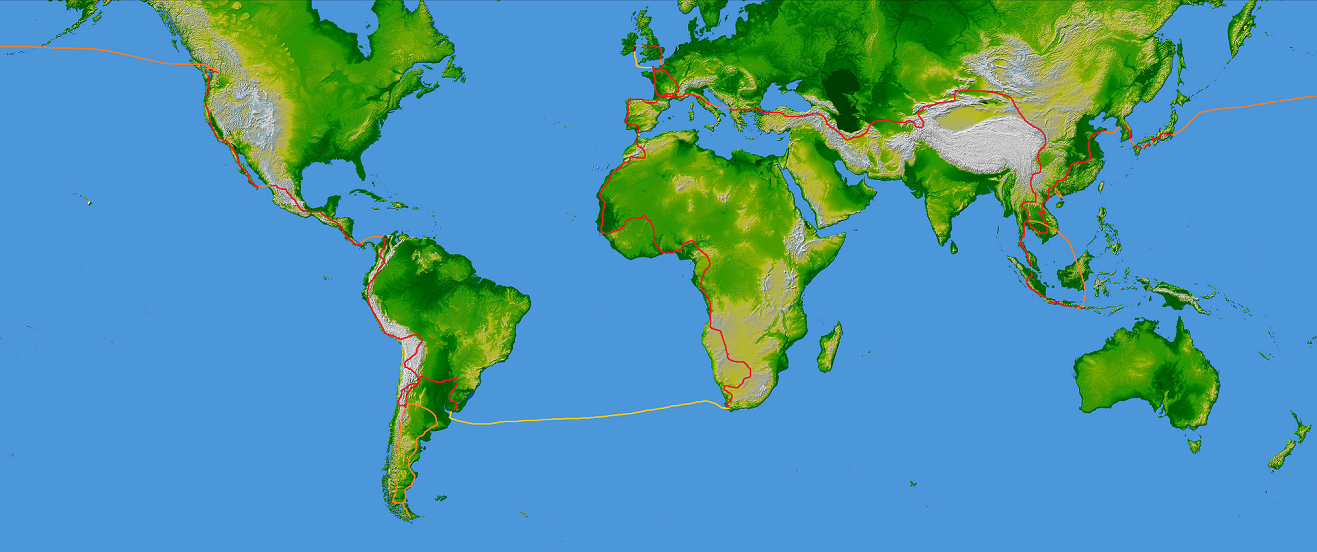
Almost 700 km of desert lay ahead of us after we passed through the Great Wall leaving Jiayuguan. The old 312 and the new G30 motorway diverge from the railway line and after straying west to Anxi and Guazhou, they bear north-west across the Bei Shan mountains before descending again to the ancient oasis of Hami. Lying on the edge of two great deserts - the Gobi to the east and the Taklamakan to the west, the new motorway connects distant Beijing and China's heartland with its western regions and the northwest capital of Urumqi. Previously the Uighur population predominated until the recent migration of Han Chinese to the region diluted the ethnic pool. More on that later perhaps.

Back on the highway in western Gansu we spent two days struggling along the old 312, battling headwinds and a road that had often ceased to exist in all but name as the construction of the western high-speed train line has involved the removal of much of the old road. Trucks threw up tremendous amounts of sand that combined with the headwind made for choking conditions at times and pretty miserable cycling. By the third day we decided to follow the advice of Sam, a cyclist we met a week back, and get on the G30 to Anxi. With a tailwind we were eating our morning noodles by midday with a 100 km on the clock. We had found our spirit of the desert again. After Anxi, the 312 disappeared into sand piles and one look at it and we were scrambling back over the barbed wire fences onto the highway.  The advantage of having to ride the motorway is that you have a wonderful surface and a lane (the shoulder) to ourselves. Colossal trucks rumble past and provide a bulwark against headwinds and its easy to find a camping spot in an underpass or drainage tunnel, as the highway is sealed off from the desert by a fence. On the other hand, supplies are much farther apart than the old road and distances of over 100 km between supply points were commom. Also all the livestock hauliers heading west dump their dead carcasses by the roadside, leaving a foul stench and the sight of bloated, rotting pigs and sheep. PETA could have a field day here. Despite the signs, there's no restrictions to using the highway now that the old 312 road has been carved up, although the police pulled up once as we snacked on our extensive biscuit supply and told us to pull off further up the road where it was wider. We also got papparazzi'ed by an unsmiling police photographer at one toll booth.

We couldn't reach Liuyuan service centre on the first evening as we climbed into the Bei Shan (Black Mountains) and after removing all the dessicated turds that previous occupants had left in our evenings abode - an underpass - we had to save our water for drinking and skip breakfast before we made the service area by 10 a.m. the following morning. Lesson learnt about supplies. We are camels once more. We were delighted to find a buffet at the service area, where truckers dove into plates piled high with calorie goodness, unsure of whether to eat their breakfast or look at us eating ours. In between high-decibel conversations, those who had disappeared to the bathroom could be heard hocking up and spitting through their morning abultions. Our neighours were on the baijou (Chinese spirit) and beer already. Hopefully their truck has an autopilot. We left in a headwind, our bikes wobbling under the weight of water. We wouldn't make the provincial border post of Xingxingxia that evening and camped up under an amazing night sky. Finally some darkness and peace in a land where solitude is often hard to find. This is a different China out here. And its back to the basics (and the best parts) of cycling as we pitched up each evening. Anyone for another pack of noodles?

The northern Silk route was a later addition to the more deadly southern one that runs across the southern section of the Taklamakan to Kashgar. By the sixth century, the northern route was preferred despite being longer. From Jiayuguan to Hami would have involved almost a month of trekking through the "howling wilderness" that early 20th century explorers found. Hami today is famous throughout China for its production of over 30 varieties of melon. It's also famous for wine and grape vines struggled against the wind as we rode into town yesterday. We crossed the border into Xinjiang autonomous region two days ago at the remote outpost of Xingxingxia with just a nod from a friendly policeman who surveyed the lines of migrant workers queuing up to get their documents checked.

Two nights ago at over 1900 metres we had all our warm gear on as a very cold northern wind blew down on the Bei Shan, while yesterday I sat sweating in the high noon heat with my second puncture of the morning. Turpan, our next goal, has temperatures in the high 30s as it sits in a synonymous depression over 50 metres below sea level - China's lowest and hottest place. It's a few days barren ride to the capital, Urumqi, from here and it's where we'll pick up our Kazakh visa and begin playing the Central Asia Great Visa Game.

Hami, Xinjiang, PRC
Pedalled: 70,864 km

Fwd: "115. Gansu to Xinjiang in pictures"

From one working camera when we entered China to three cameras (including Ellie's new ipod touch), our photos are scattered on different devices but here's a few from the past few weeks from my camera. Most of the food and people ones are on Ellie's new camera and mine are on the road...

Sunday, 5 May 2013

114. Into the Gobi

Leaving Yongchang, the Hexi corridor's famous wind finally caught up with us and kept progress in the single digits as we gradually climbed up to a pass. Settlements were sparsely scattered and after filling the panniers with supplies in Shuiquanzi from a couple of village shops we pushed on. Ellie was still dealing with the sinusitis and we crouched down in a dry irrigation trench while sipping tea from the flask. The pass itself was a wide open plain that gradually tipped forward. We camped up in a drainage tunnel under the busy G30 that gave good shelter. Ellie was asleep before our dinner of vegetables and noodles was ready. 

The wind forecast on weather underground was right again as a gentle flutter from the east soon became a ferocious tailwind. We soon got exasperated at the broken state of the old G312 as we descended towards Shandan and after 10 km we took advantage of a gap that locals had made in the fence protecting the G30 and we were soon whizzing down the motorway shoulder at 40 kph. Remnants of the Great Wall lay just to our right. The earthen wall crumbling back into the ground in many spots but still impressive as it ran to the horizon across the featureless plain.

After Shandan we met Sam, a Japanese-German transcontinental cyclist pedalling east and we chatted by the roadside for awhile before he pushed on slowly into the fierce headwind. We covered the 130 km to Zhangye by early afternoon and made our way over to Hexi university campus where Justin, an American teacher and couchsurfing host, very kindly put us up for three days while Ellie recovered. Zhangye is another important Silk Road stopover, birthplace of Khublai Khan and home to Marco Polo for a year. Little remains from that era but the city is friendly and fun to explore. We hung out with Justin and his sister  Dorothy in the evenings and caught up on some films.

Two more favourable days brought us the 250 km to Jiayuguan. The fort that guards the nearby Jiayu pass was the last stronghold during imperial China and was responsible for keeping the barbarians beyond in the desert. It was also the primary route between the Middle Kingdom and the west and linked Rome with Xian and the lands between in an exchange of goods, philosophy and ideas. Exiled poets, criminals and soldiers passed through Jiayuguan gate into oblivion, most never to return. As we walked the walls of the fort yesterday a thick pall of black smoke drifted over the site from vegetation that was being cleared giving the impression that the fort was under attack. Most of the buildings were covered in scaffolding as reconstruction takes place. Camel rides, quads and tennis ball firing cannons now stood out on the western plain where previously the barbarian armies of central Asia and demons of the Gobi would have been anxiously watched for.

Our highway, the 312, follows the northern Silk Road and over the next ten days we are desert bound for Xinjiang autonomous region and the old oasis cities of Hami and Turpan.

Jiayuguan, Gansu, PRC
Pedalled: 70,234 km

Friday, 26 April 2013

113. Rockin' and rollin' in Gansu: Over the Wushaoling Pass and up the Hexi Corridor

Four wonderful days of doing little except hanging out in the company
of good people with our host Kevin and his friends in Lanzhou and we
were back on the bikes riding west along the Yellow River and chasing
a tourer who had a billowing skull and cross bones mounted on the back
of his laden bike. With no mutual words to share except place names on
maps, we established that he was from Shaanxi province and bound for
Lhasa - a popular pilgrimmage route for young Chinese tourers these
days who can travel without permit problems onto the roof of the
world. At a railway crossing our silent smiling companion hit the road
when his wheels caught in the lines and he picked himself up and
dusted down his torn trousers signalling he was ok. Shortly after we
waved goodbye and stopped for a late and extortionate lunch of beef
and vegetables.

We crossed north over the Yellow River and headed up the G312 - the
highway that will take us the remaining 2700 odd kilometres across
western China. Originating in Shanghai on the east coast, the G312
crosses China along some of the ancient trading routes that were known
as the Silk Road. The new G30 motorway and the busy western railway
line also accompanied the venerable and aged original G312 up a wide
valley towards the Daban Shan mountains. Our first night out saw us
pitch up in a sheltered sliver of ploughed but not yet planted field
on the edge of a village. In the morning we cooked our porridge under
the silent gaze of an old farmer who had first judged us from afar and
then curiousity got the better of him and stood above us for a few
minutes before wandering back towards the village. Other villagers
return smiles and wave at us as we push our bikes back to the road and
ride north.

With a more sluggish pace we continued up the gentle incline into an
unfavourable wind as men and women took to their fields. We passed
Yongdeng and then through the Tianzhu Tibetan autonomous county while
a black sky gathered on the Daban Shan and we arrived into Dachaigou
in our rain gear with cold, wet faces. Only about 23 km short of the
summit of our almost 3000 metre Wushaoling pass, winter was still here
as we tried to unsuccessfully arrange a bed for the night, the local
police insisting we'd have to backtrack the 20 km we'd just toiled up
from Tianzhu rather than stay at the local guesthouse. The rain was
easing but flakes of snow began to fall as we cursed the ridiculous
rules and bade farewell to the warmth of the stove-heated police
station and headed out into the freezing headwind with supplies for
the night. Fortunately we struck lucky a few kilometres out of town
and found an excavated site off the road where we could pitch up out
of the worst excesses of the wind. Using all our cold weather gear and
winter sleeping bags the night was pretty comfortable except for the
dashes outside when nature called. We woke up to blue sky and
snow-covered mountains surrounding us. We pushed on up towards the
pass and after collecting some hot water for the flask and supplies at
a village shop we reached Wushaoling's windy summit (2990 metres) at
about 10 a.m. before descending below the snow-line into Anyuan where
we had steamed buns and eggs for a late breakfast around a luke warm
stove.

We were aiming for Wuwei, an important outpost of the Middle Kingdom
on the lower edge of the Gobi and the eastern end of the Hexi
Corridor, and stripped off layers as we dropped over 1500 meters into
the bustling little city. After no success with the cheaper lodging
options we resorted to the guidebook's recommendation, a fancy hotel
beside the reconstructed and impressive south gate, where for the
second time in a couple of weeks I was carting our Gobi sand-covered
paraphernalia around a fancy hotel with a luggage trolley.

We decided to take a day off to check out the sights including the
ancient bell tower that stands in the midde of a derelict site and the
Confucious temple and stele that are a Chinese version of the Rosetta
stone making translations possible from a double-sided stele featuring
the ancient Xin characters on one side and the more modern Chinese
characters on the other. Unlike other tourist sights in China, in this
part of the country you feel like you have discovered them yourself as
you wander alone.

With weather reports showing a generous tailwind we were back on our
bikes the next day with plans to reach Zhangye in three days time and
stay with another Peace Corps volunteer. Ellie was struggling though
with a cold and sinusitis and so we pulled over in Yongchang after a
local young rocker pulled up on his flashy motorbike and invited us
for lunch. Vinny as his friends call him is not exactly what one
expects to find in the Gansu desert - an accomplanished rock guitarist
speaking excellent English with his own bar and a passion for fast
motorbikes, the 26 year old brought us out for dinner in the evening
with his friends after finding us a hotel room across the street from
his pool/rock bar. He also fetched Ellie some tradtional chinese
medicine for her sinus.

Another stopover today in Yongchang to let Ellie recover before we
move on up the Hexi Corridor to Zhangye over the next couple of days.

Yongchang, Gansu, PRC
Pedalled: 69,784 km

Sunday, 21 April 2013

112. Over the mountains to Lanzhou

We rode out of Chengdu in a convoy of three, with our companion Mark setting the pace for the first day that ensured we blew off the cobwebs from our month long layover. We almost reached Mianyang before taking a room on the roadside. Like some of the newer hotels we have lodged in before, our shared bedroom came with a clear glass screened shower and squat toilet, so those wishing to spectate can do so if they please.  Mark was bound for Songpan and we said goodbye the next morning before we rode through a soggy Mianyang. One of Sichuan's main cities and with a population equivalent to Ireland, the city was close to the epicentre of the 2008 earthquake that had caused particularly severe damage to schools and left an estimated 7000 pupils dead in the city alone. 

The G108 became quieter on the third day after Zitong as it wound up into the cypress covered hillside around Qiqushan temple. We have met a lot of local cyclists out touring over the past couple of weeks which is great to see. One fellow from Guangzhou had already clocked up 12000 km on a tour around China. One day we passed a trio on roller blades.

We ended up in Sichuan's northern city of Guangyuan after five days and almost chose a longer route via Xian as there was still some concern that there was no diagnosis over my guts and it might be better to stay closer to bigger towns than the more remote route over the mountains. That evening though I got the good news that the tests done in Hong Kong had finally proven amoebic colitis caused by an infection I had picked up along the road and which I had been treated for. So with this news we doubled back 20 km on the G108 and joined the 212 that would take us almost 800 km over the mountains to Gansu's provincial capital in Lanzhou. We had been evicted from our standard cheap hotel in Guangyuan as the city is the site of a nuclear facility and the authorities are more jittery than normal about the presence of hairy big-noses so we found ourselves confined to the posh international hotel where we had to fork out 25 euros for a fancy room - about five times are normal rate in China. For the first and hopefully last time on the trip a bemused bell boy loaded our mud spattered panniers onto the trolley and up to our quarters on the umpteenth floor. 

Across the provincial border in Gansu we entered one of China's poorest provinces although the construction continued even in these isolated mountains as the pillar foundations and tunnels for an elevated highway and a high speed train were being put in. Few foreigners make it this way and curiosity increased among the locals and the authorities. Most evenings the police would have heard about the cycling laowais in town and turn up with and bilingual registration forms for the legal aliens. I don't know where a this paper work ends up or if there's a central system charting our progress. 

The further north we went the landscape shrivelled up and desiccated hillsides through dust clouds in the air when gusts of wind blew. The harsh landscape was also etched into the faces of those who survive here. Those old enough may have experienced the horrors of the famine as a result of Mao's misguided policies in the late 1950s. Gansu and Sichuan were two of the worst affected areas in the country. This land is the cultural crossroads of China. The red-cheeked highlanders mix with Han and the Muslim Hui. The latter appearing to have cornered much of the market with their fresh noodles that closely resemble pasta. Mosques are another feature that lets Islamic Central Asia presence feel much closer now.

For the past few days we've been staying with Kevin, a Peace Corps volunteer who works at a university here in Lanzhou. We've spent time with several of the volunteers and Kevin asked us to give a talk to his students about the trip which was attended by about forty enthusiastic faces who were very engaged and curious. Life for most of the students here is quite strict and for the duration of their degree they share eight bed dormitories and have evening curfews. For many it's their first step of independence and can be quite a challenge for them to learn how to fend for themselves. Real freedom doesn't really commence until they graduate and begin working but social expectations that marriage should follow quite quickly puts pressure on young people to settle down before too long.

Lanzhou is also the point at which we join the historical trading routes that established the Silk Road. Lying on the upper reaches of the Yellow River, Lanzhou has long been an important outpost of the Middle Kingdom. The farthest reaches of the Great Wall lay just to the north of here, between the southern fringe of the Gobi desert and the Qilian Shan range where we will push north through Gansu's narrow waist, known as the Hexi corridor, in the coming fortnight.

Lanzhou, Gansu, PRC
Pedalled: 69,419 km

Friday, 29 March 2013

111. One Sunday morning in Hong Kong...

On Sundays in downtown Hong Kong many of the domestic helpers who live and work in Hong Kong's wealthier households, gather in the city's parks and on the pavements to enjoy their designated day off in the company of fellow migrants - mostly from the Philippines and Indonesia. There are approximately 300,000 domestic helpers (or 3% of Hong Kong's popultion). Last Monday, according to the New York Times, "the highest court in Hong Kong ruled unamimously that a woman from the Philippines who had lived and worked there for nearly 27 years as a domestic helper was not entitled to permanent residency, ending an acrimonious legal fight over the immigration rights of migrant workers."

Last Sunday was Cordillera Day where campaign groups in the mountainous regions of Luzon in the Philippines raise awareness of human rights abuses and the threat that activities such as mining and logging are having on the indigenous communities there. Some of the Filipino's working in Hong Kong also took to the streets with banners and music, dancing down the cordoned-off streets.

After following the parade for a short while we headed for the hills and hiked around the Peak overlooking Hong Kong harbour and Kowloon, amidst hundreds of Scouts running the trails.

We spent ten days in Hong Kong and our warmshowers host, Phil, who had first hosted us 18 months ago on our first visit here, very kindly put up with us again, fed us, navigated us and also brought us in to his school one day before they closed for the Easter holidays. In between doctor's visits we got to explore the mega-city some more and also got some bit and pieces for the bikes that are hard to come by in China (like a new crank set for Ellie's Long Haul Trucker) and had a good rest too. We returned to Chengdu with a (fingers crossed) clean bill of health on Wednesday and hope to be back on the bikes at the weekend, northbound for the mountains and Lanzhou, after a long month off our saddles.

Chengdu, China