Route map

Route map
Route map 2008-2014

Riding days

Riding days

Thursday, 18 July 2013

121. To the Ferghana valley: from Bishkek to Osh

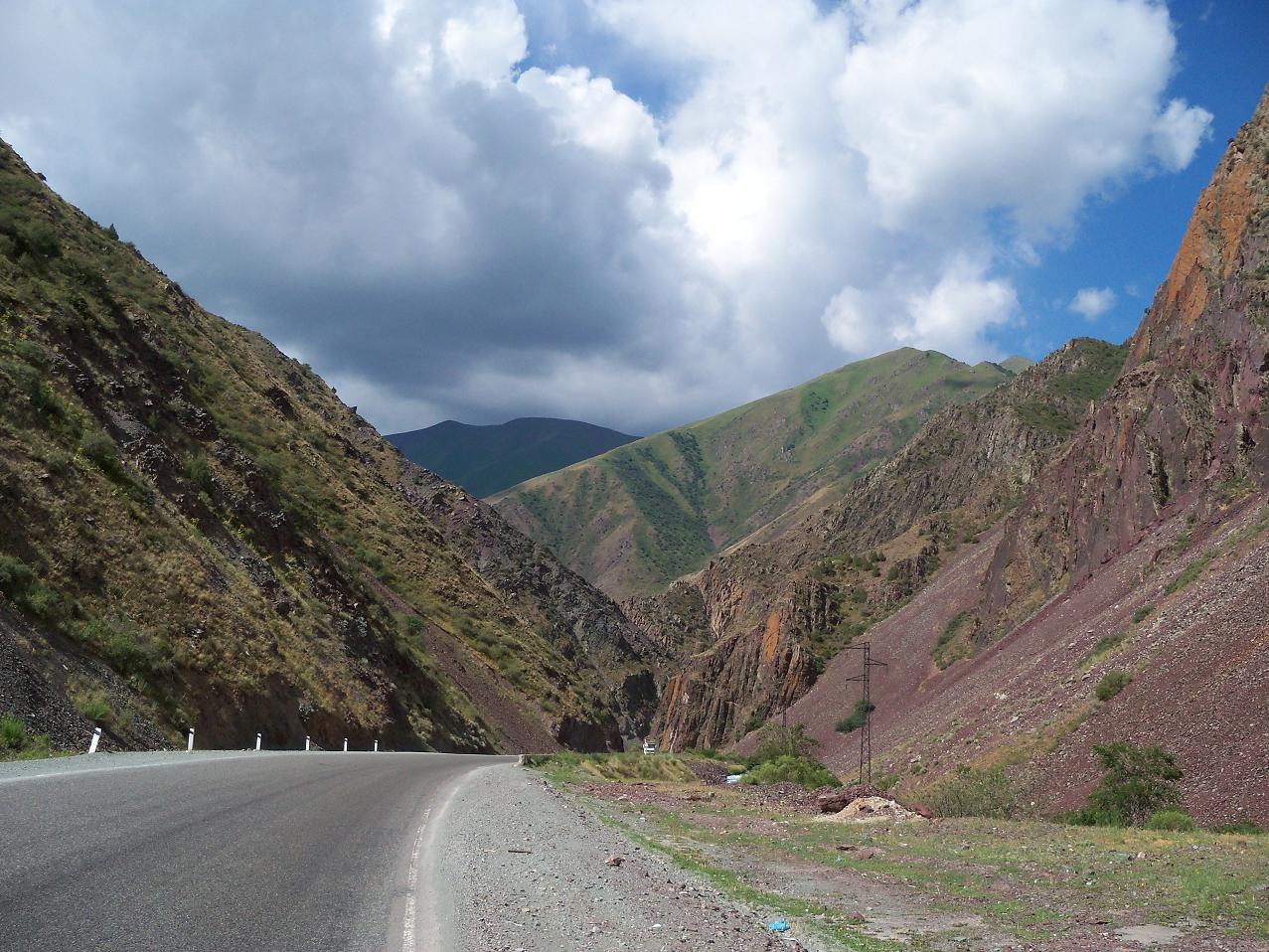
Climbing into the hills above Kara Balta, the wide open expanse of the Kazakh plains stretched northwards until they blended with the sky. We set up our new abode (an MSR Mutha Hubba) under the shade of some fruit trees in a cafe just beyond the village of Sosnovka and following our meal of laghman (noodle stew) and borsch, our hosts brought out a large bowl of raspberries, as we admired and critized our new home. The climb up to the Too-Ashuu tunnel at close to 3000 metres was a long, steep one and culminated in a series of impressive switchbacks. We finished the last 14 km of the climb on our second day out from Bishkek, having camped up in the room of a jailoo (summer farm) when the heavens opened the previous afternoon. The family ushered us into the spartan room, completely bare except for a dirty rug on the floor and the contents of a recently butchered sheep in a large cauldron. The head of the animal lay in the hallway, eyeing me vaguely. A large sheep skin was lain down and we had the place to ourselves for the rest of the day while the family built pens for the cattle, sheep and horses.

The following morning we reached the notorious Tor-Ashuu tunnel, a 3 km long Soviet-era construction that bore through the mountainside and out into the Suusamyr valley. Rain and then snow ensured we were pretty cold as we waited at the tunnel entrance for a friendly truck to bring us through to the other side. With a gentle uphill incline, cyclists are usually told not to ride through the unlit, dusty passage where with little room to spare, trucks still attempt overtaking manoeuveurs. A soldier at the checkpoint took pity on us and brought us into his heated bedroom in the barracks where we thawed out with tea and central heating and ate the few bits and pieces of bread that I scavenged from a nearby wagon.

The sun was shining onto the deep green fertile grassland on the other side as we descended from the tunnel into the Suusamyr valley. Yurts lined the roadside for kilometres, all brewing kymys (fermented mare's milk) and other diary products from the grazing animals. We asked to camp in the grounds of a small clinic that served a 100 kilometre stretch of road but instead we were shown into one of the empty patient's wards, a spartan two-bed room, and allowed to sleep in the warmth. Later that evening I chatted with the ambulance driver who was very keen to ask questions about Europe and Ireland. In his gentle manner and with no common language we covered a variety of topics from crops to wages to some politics. He was nostalgic for the Soviet Union and regretted its collapse. As a tank driver in the 80s he had been stationed for two years in Vladivostock. Now he earns $100 per month driving and repairing the antique ambulance that our bikes shared the garage with for the evening. The following morning we were invited to breakfast with the several staff on bread, butter, jam and lamb and copious cups of tea. More bread and butter for the road ahead was handed to us as we headed on up to the second pass at 3200 metres. Plied with bowls of kmymys from  a Bishkek family that summers up in the hills and more food from another yurt when we dived in to avoid a rain shower we climbed the 25 km out of the valley to the summit. Fortunately the rain cleared as we neared the top and we were rewarded with a blue sky and sunset before we descended down towards Tortogul and a peaceful camping spot by the river.

The next few days we spent in the much dryer and sun-scorched landscape that circled the Tortogul reservoir before following the dammed Naryn river down into the Ferghana valley. Old railroads and highways that used to cross the ethnic Soviet republics effortlessly in the old times were all severed after independence and we rode along the Uzbek - Kyrgyz border towards Kochkor-Ata and Jalalabad. The latter, along with Ozgen and Osh, were the scene of bitter, vicious riots in 1990 and 2010, when due to the culmination of several factors such as economic decline, Uzbekistan's policy of secularisation in an otherwise religiously conservative region, and political conflict many hundreds were killed. The Ferghana valley has been a historically important crossroads for the past couple of millienia and is still an important agricultural centre in an otherwise barren landscape. The sister river of the Amu Darya, the Syr Darya, irrigates the fields with the runoff from the Kyrgyz mountains before flowing to the ever diminishing Aral Sea.

The region is still an important crossroads today for pedallers too and we've met many cyclists in the past few days and more still in Tes Guesthouse where our tent is pitched up for the past couple of nights as we gather provisions for the Pamir highway that officially begins in Osh.



Osh, Kyrgyzstan
Pedalled: 73,675 km

Thursday, 4 July 2013

120. Into the wild - from Kazakhstan to Kyrgyzstan

We enjoyed our three day jaunt across Kazakhstan. The wide open spaces of the remote southeastern corner, the small towns with friendly folk. Less so the million mosquitos that gathered around us each evening and the three seasons in 24 hours - from hot sunshine on the steppe to cold rain on the climb up to Kegen and the Karkara valley and then the sleet that fell as we passed through the recently reopened Karkara valley border crossing between Kazakhstan and its mountainous southern neighbour - Kyrgyzstan. Our parting from Kazakhstan was a warm one from the friendly Kazakh customs officers who spiked our hot cups of coffee with shots of vodka. Kazakhstan is larger than western Europe and we'd only seen a snippet of the vast country that stretches all the way to the oil rich Caspian Sea. Like the other 'stans in the region - the name of the country tries to evoke a mono-ethnic idyll that belies the truth of its multiethnic population. While Kazakh and Russian groups dominate, smaller minorities also have a significant presence including Uighur, Kyrgyz, and Uzbek. Other groups such as the Poles, Germans, Tatars and Ukrainians who were often forcibly settled in the region during the early years of the Soviet Union have also made significant contributions to the country, although many of these groups have migrated west again since 1991 and the end of the USSR.

Our second country in central Asia and another one of the former fifteen Soviet Republics was Kyrgyzstan. Shortly before leaving China we were able to confirm that the Karkara valley border crossing was reopen again for business having been closed after the political turmoil in Kyrgyzstan in 2010. Renowned as one of the most picturesque border crossings in central Asia, Karkara valley is home to a summer population of cowboys and yurts bringing their livestock up to graze on the knee-deep grass alongside black cranes breaking their journey from Siberia to South Africa and back. As the rain turned to sleet and a vain attempt to find some dry ground in a soggy landscape, we turned towards a ramshackle village to pitch our tent up. The village was mostly young men who were here to herd for the summer months. A couple were drunk but most stood at a discreet distance and watched inquisitively as the tent went up. A man came up and insisted on making us tea and storing our bikes in his shed. We'd perish with the cold he said. We would have to sleep inside. The dogs will bark all night at us he told us. Although very cold, we knew our gear was up to the task however and we splashed back across the wet grass to our cold abode. Eventually the enormous dogs also relaxed and their barking ceased. We woke up to snow covered hillsides and spent the day riding our way down to Tup and Issy Kul lake on a road that improved from gravel to hard dirt to tarmac.

In Tup we found lodgings in the dining room of a lady running a cafe. Evening tea was served in fine china under chandeliers and a long table. A bookcase full of dusty Russian works loomed over us. Outside in the garden, apple and apricot tree branches were getting heavier with their fruit by the day. For the next two days we rode west along the northern shore of lake Issy Kul. The second largest high-altitude lake after Lake Titicaca. Formerly a testing ground for Soviet naval weapons, the 700 metre deep lake now tries to prosper from gentler means, especially tourism. Speedo-clad Kazaks and Russians flock to the lake during the summer months. Rising up from the southern shore, the snow-topped Tian Shan stretches along the Chinese-Kyrgyz border. High in the mountains is also the site of Kumtor gold mine, a large Canadian-managed operation that was recently in the press due to protests calling for its nationalisation.

Descending from the lake to the lowlands at Kemin we rolled towards Bishkek and shortly before Tokmok a bullet sized metal pin did some damage to my rear tyre as darkness rolled in. Unable to find a quiet spot to camp we asked at a roadside shop if we could camp in the garden. It was no problem of course. In a land where the semi-nomadic traditions of its highland population are still alive and well, asking for a place to camp is rarely met with any source of concern, even amongst the settled inhabitants. More perplexing for our hosts is our lack of interest in drinking vodka after a long day in the saddle.

Village shops are awash in familiar goods - dairy products and bread - in a diet that although very heavily meat based, is still much more familiar to us than that of east Asia. The other half of the shop is dedicated to the several dozen varieties of vodka that creak the shelves. The macho culture is also a new phenonomen. Fast, reckless driving and prolific drinking along with a swagger that one would almost never see in eastern Asia is disconcerting.

With its relaxed visa regulations, Kyrgyzstan and its capital, Bishkek, was going to be a stopover on our route west. Stocking up on visas for the countries ahead, we picked up our Tajik, Uzbek and Iranian visas last week. Ellie battled the flu for a few days and my mother made the trip out from Ireland for ten days and we spent a few days exploring the city and then up to the mountains at Kochkor and Song Kol lake where yurts were erected on the summer pastures. A successful community-based tourism association offers homestays in the region and we spent a memorable night with a family by the 3070 metre high lake.

We're back on the road in the next day or two, back to the mountains, bound for southern Kyrgyzstan and the Ferghana valley before crossing into Tajikistan to ride the Pamir highway around to Dushanbe.

Into Kazakhstan

Real men drink beer for breakfast 


Baby camel and its mother by the roadside

At last we get to use our headnets...

Quiet reading time in the drainage tunnel

Approaching the Kazakhstan-Kyrgyzstan border post in the Karkara valley

First night in Kyrgyzstan - snow, dogs and village camping

Kyrgyz cowboys

Village shop

Approaching Issy Kul lake, near Tup

Issy kul 

Issy Kul

Graveyards

Descending to the lowlands and Bishkek

Camping in this family's garden

On the train

Driving up to Song Kol


More Lada promotional footage...


Kids at Song Kol

Yurts

Song Kol

Home for the night

Song Kol

Dinner time

Vodka time


View The Slow Way Home - Map 2 in a larger map


Bishkek, Kyrgyzstan
Pedalled: 72,985 km

Please note that as part of this trip I am fundraising for the Dublin-based Peter McVerry Trust who work primarily with supporting homeless youth and this year they mark their 30th anniversary. If you would like to make a donation, you can do so via my fundraising page on the mycharity.ie website (click here). Thank you.

Sunday, 16 June 2013

119. A few photos from Xinjiang


Someone turned the internet in China off the other day before I could post these photos of the ride from Urumqi to the border...

Yesterday we crossed into Kazakhstan.

We were met by a smiling immigration officer, "Give me prezent!". Failing to get any more financial reward he demanded our Kazakh medical card. "You don't have Kazakh medical card?!?" Finally we were stamped in.

Since then it has been great. Small roads, small towns and a ride across the steppe to the hills where we will climb up to the recently reopened border crossing in the Karkara valley. Learning some Russian and declining mid-morning vodka offers.

A drainage tunnel near Shonzhy, Kazakhstan
Pedalled: 72,395 km

Friday, 14 June 2013

118. To the end of China

On the evening of my birthday, the Fed Ex tracking information changed from a forbidding red to a more pleasing blue and informed me that my replacement gear unit that Rohloff was shipping out from Germany had cleared customs and would be in Urumqi shortly. Three days later, with a newly installed gear unit running smoothly, we rode out of town at the ridiculous hour of 4 p.m. Here in western China, when you have sunlight until 10:30 pm now, you can do that sort of thing. The day prior to leaving I was down in one of the bike shops near the hostel getting some bits and pieces when I ran into Paul. We chatted for a bit, always eager to share tales from the road and in particular as we were going the same direction. Paul is riding from Korea back to the Gloucestershire. Before we headed back to the hostel to pick up Ellie and go for dinner we realised that we had a mutual friend - Troy, our Yankee cycling partner in southern Thailand and Malaysia last year who abandoned us for a boat. Troy had mentioned a couple of months back in an email that he knew someone who was also heading east this year and then in the middle of all this vastness we meet in a bike shop in Urumqi. But the small world got smaller when we also realised later that Paul's sister and Ellie's brother are old friends and Paul's sister works in Hanoi, Vietnam - where we met her for a pig brain feast when we passed through the city. Unfortunately Paul was waiting another few days for both his Kazakh visa and a package of bike bits, so it will probably be Bishkek before we catch up again.

So we left Paul and rode out of Urumqi and straight into the airport where we sheltered from some rain. We got lost a bit here trying to find the way onto the G312 and our route west but eventually got on track and dodged more showers as we passed through Changji. The few hundred kilometres along the northern foothills of the Tian Shan are completely different from the desert section we rode through in eastern Xinjiang. Here leafy towns are fed by tunnels that flow with meltwater and runoff from the mountains nearby, trees and green fields line the road for much of the way. It's also a lot more populated - migrant Chinese workers along with ethnic minorities such as Uigher, Kazakh and Mongol - living what seem like quite separate lives. Finding a quiet place to pitch up was slightly more challenging on this section and we often had to wait until dusk (10 p.m.) before diving in for cover off the roadside. After some forays past the ever-present roadworks, we got back onto the G30 motorway and headed west. Often one side of the motorway was still closed to traffic but we could get on and ride for kilometres with three lanes of perfect asphalt to ourselves while the motorists battled it out on the other side of the divide. Wonderful.

As we ate at a Muslim restaurant by the roadside near Jinghe the women motioned to the skies to indicate that a big storm was coming. Sure enough, a few minutes later a dust storm blew through and coated everything in the fine dust for a couple of hours. In the evening we continued on our way with a tailwind blowing us closer to where we'd start our climb over the Tian Shan and down to the border. That evening, however, we ended up arriving at night into a small town off the highway. The town was a mixture of Han and Muslim and we contemplated our options for the night. Since we already had 140 km on the clock, riding out in the dark to find a camping spot seemed like hard work, especially as there were no obvious places in the wide, open fields on the way in. Checking in at the one small hotel we could see would no doubt arose the authorities to our presence and we'd have to go through the usual form filling and registration. So instead we opted to ask at the police station if we could stay somewhere and we were quickly led by a team of eager young officers who were in the midst of a basketball game towards the hotel we'd seen. Halfway there however and we did a u-turn back to the station as it dawned on the sergeant that we should really go through all the registering and form filling and form stamping and questions before we settled into a room. They were an eager and pretty friendly bunch of officers and we sat in a room upstairs and asked all sorts of questions while our passports where thumbed through by everyone. Finally at midnight we got to go to bed.

Back out on the road the next day we continued towards our goal of the high altitude lake of Sayram Hu. Something hadn't agreed with Ellie, however, and she felt quite sick whilst we got her rear puncture fixed. A few kilometres on a rest stop appeared with a restaurant and petrol station and we parked up out of the coming thunderstorm and Ellie fell asleep on a worn couch in the restaurant while I ate tofu and beef noodles. By the late afternoon Ellie felt well enough to ride on and we climbed 16 km before pitching up under a bridge. The next day we reached Sayram lake which has a spectacular setting amid the snow-capped peaks of the Tian Shan. Like many tourist sites in the country, however, it is undergoing an environmental apocalypse with trucks and diggers carving up the countryside for hotels and plastic yurts. They wanted 10 dollars each for us to enter, so we declined and rode on and found a gap in the fence along the highway and pitched up by the shoreline. Dinner was a bag full of vegetables that the cooks at the hotel beside the tourist centre insisted on giving us along with some bread.

The following morning we rode along the edge of the lake, passing a small yurt village, where the summer inhabitants fatten their animals on the grass whilst playing cowboys for the passing tourists and giving horserides. Transhumance continues today and as we descended back to the lowlands on the incredible new G30 that winds its way in a serpentine manner through tunnels and along elevated sections of highway, herders on horseback urged their flocks of sheep and goats up the other side of the highway to their summer pastures. We dropped down from 2100 metres to 800 metres and after a final double whammy with two punctures in my rear tube (all from the metal shards of blown out truck tyres) and a strong headwind we reached Khorgas and the border to Kazakhstan. Signs now appear in Russian and most people assume we're Russian, the lady of our hotel showing me the room yesterday and proudly stating that they had a Russian language news channel. We're having a rest day today here in Khorgas before crossing the border and into Kazakhstan tomorrow. We've covered 5,857 km in China this time around, averaging 85 km per day over 69 riding days. Together with the first leg I rode in 2011 through eastern China (when Ellie was back home recovering from a fractured elbow), it means I'll have ridden over 10,000 km in China alone, or about 12-14 per cent of the journey's total. Cycling-wise, western China has been a lot more pleasurable with its wide open spaces, less hectic roads and return to camping. Its still incredible to comprehend the scale and pace of development that is happening in this part of the world and its often hard not to be critical about the impact that future generations will bear, particularly in terms of damage and stress on the environment. While interactions with many of the people we meet on a daily basis are often greatly inhibited by the lack of our linguistic skills, we've almost always been met with smiles and wonderful encouragement from a country and people that have come through a lot.
Khorgas, Xinjiang, China
Pedalled: 72,223 km
Please note that as part of this trip I am fundraising for the Dublin-based Peter McVerry Trust who work primarily with supporting homeless youth and this year they mark their 30th anniversary. If you would like to make a donation, you can do so via my fundraising page on the mycharity.ie website (click here). Thank you.

Monday, 3 June 2013

117. Once were cyclists - an update from Urumqi


Two weeks ago we rolled down into Urumqi with the snow capped Bogda Shan overlooking our descent into the city. Six hundred kilometres had brought us from Hami through the Turpan depression and finally over the mountains to the capital of the Xinjiang autonomous region. Fairly standard desert riding with plenty of sand and wind thrown into the mix. Towns tend towards the extremes here and either you find yourself in a Chinese looking town or else feel like we're already further on central Asia with Uighur dominated settlements. Turpan itself was a mixture of both worlds and on our last night rather than having an early night like good little cyclists we were taken out by a couple of off-duty (but still camoflaged) police guys and we ended up attending a fascinating Uighur wedding before the night was out.

Having read the experience that my friend's Daren and Tati had with the wind after Turpan a couple of years back, I figured we had lucked out as a gentle tailwind followed us out of Urumqi. However, a few hours later we were also pushing our bikes along the shoulder as a dangerous crosswind kept blowing us into the traffic. We found a dip in the ground amid the wind turbines to pitch the tent and wait for the morning calm which never came. Our tent got battered mercilessly throughout the night and tore our flysheet slightly. After another hour in the wind the following morning we reached the hills again and began the climb up to Dabangcheng and down to Urumqi.

We knew we'd be a few days, probably a week, waiting on our Kazakhstan visa in Urumqi and while that was in the works we set about getting the Gobi out of all our gear and some TLC for our bikes. However, I discovered that two out of five bolts that hold an axle plate in place on my Rohloff gear hub had sheared off and another went as I took the plate off to have a closer look. This wasn't good. Some emails to the very helpful people at Rohloff and they offered to send me out a new unit under their 'moon and back' warranty. Wonderful. However, the three day service that Fed Ex promises from Germany to Urumqi didn't reckon on the intervention of Chinese customs, so now we're waiting for it to clear customs where it has been sitting for the past week in Beijing. Hopefully it'll make it in the next day or two before we continue west towards Kazakhstan - just under 700 km east.

Meanwhile we're settled into a hostel in Urumqi, which is the main transport hub for the region and we've made a few friends including a great group of other cyclists who have all been and gone. Urumqi, with its ethic mix, is an interesting city to explore although much of the time has been spent researching the route ahead across central Asia and applying for letter of invitation that we'll use with our visa applications once we reach Bishkek, Kyrgyzstan, in a couple of weeks time.

Today, thanks to Ellie, we had cake for breakfast. You're allowed do that when you're an old man.

Urumqi, Xinjiang, P.R.C.
Pedaled: 71,486 km